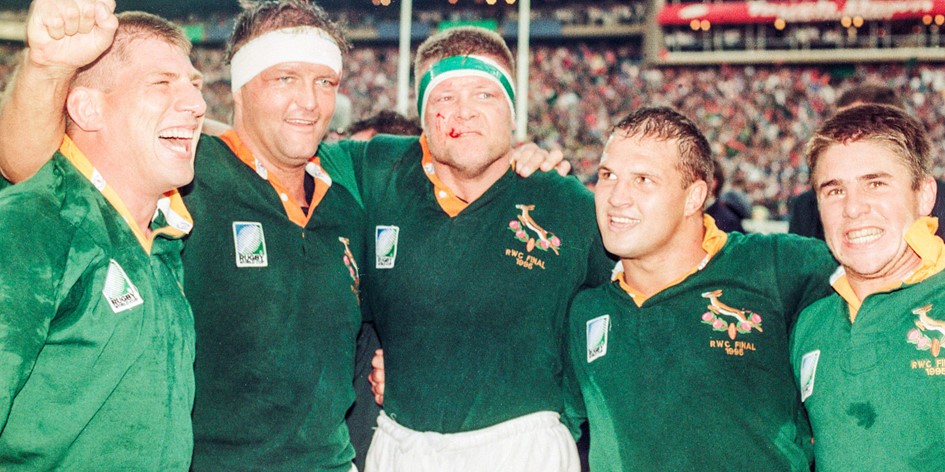
There are moments in a nation’s story that linger far beyond the time in which they occurred—moments that etch themselves into collective memory and refuse to fade. South Africa’s victory in the 1995 Rugby World Cup is one of those rare moments, a point in history when sport transcended the boundaries of competition and entered the realm of cultural rebirth. It was a victory written not only in the final score, but in the hearts of millions who witnessed a nation redefining itself in real time. To this day, the triumph at Ellis Park remains a living reminder of what unity can look like, even after decades of division.
The Weight of a Nation Before Kickoff
To understand why the 1995 Rugby World Cup still holds such power, one must revisit the atmosphere that surrounded South Africa at the time. Only one year earlier, the country had held its first democratic elections. The wounds of apartheid were not just fresh—they were still open, raw, and visible. The idea of a united South Africa felt fragile, almost theoretical. Communities were still learning how to coexist, institutions were undergoing transformation, and trust was something the country had yet to rebuild.
Rugby itself was a symbol of this tension. It had been seen for decades as the sport of the white minority, particularly Afrikaners, and was often resented or ignored by the non-white majority. For many South Africans, the Springbok emblem symbolized a painful era. And yet, the nation found itself hosting the Rugby World Cup, inviting the world to witness a tournament unfolding inside a country wrestling with its own rebirth.
It was against this backdrop that the 1995 Springbok team assembled—not just as athletes, but inadvertently as ambassadors of possibility. Their journey set the stage for one of the most defining moments in modern South African history.
The Build-Up to the Final at Ellis Park
South Africa entered the tournament ranked seventh in the world and widely underestimated. Few believed they could make it past the group stages, let alone reach the final. Yet with each match, the Springboks grew stronger, more cohesive, and increasingly inspired by the wave of national support that began to build around them. Their performance was not just about technical prowess—it was about resolve, grit, and the energy of a country yearning for a shared victory.
By the time they defeated France in a dramatic, rain-drenched semifinal, the Springboks had done something few expected: they had begun to unite South Africans across racial and cultural lines. People who had never watched a rugby match before found themselves shouting at televisions, cheering alongside strangers, discovering a common language in the tension and excitement of each play. The sport that once symbolized division was transforming into a catalyst for connection.
The anticipation leading up to the final against the mighty New Zealand All Blacks was electric. On June 24, 1995, Ellis Park in Johannesburg filled with the hope of a nation. Helicopters buzzed overhead, flags waved from every corner, and a palpable sense of history in the making settled over the stadium.
Then Nelson Mandela stepped onto the field.
Mandela in the Number 6 Jersey
Few images in modern history are as iconic as Nelson Mandela walking across the pitch wearing the green Springbok jersey—the number 6, the number of team captain Francois Pienaar. It was an act so unexpected, so symbolic, that even before the match began, something fundamental had shifted.
For decades, the Springbok emblem had been despised by many Black South Africans. Yet here was the country’s first Black president embracing it publicly, not as a symbol of the past, but as a statement about the future. “One team, one country,” he had said repeatedly throughout the tournament, and this visual gesture drove that message deeper than words ever could.
As Mandela greeted the players, the stadium erupted into a roar that carried an emotional force strong enough to leave even the most hardened athletes stunned. Many have since described that moment as the spark that fueled the team’s confidence for the battle ahead.
The Game That Tested Every Nerve
The final was not merely a rugby match—it was an emotional marathon. South Africa entered the field as underdogs facing an All Blacks side powered by Jonah Lomu, the unstoppable force who had already terrorized defenses throughout the tournament. The Springboks responded with a strategy centered on grit: relentless defense, tactical kicking, and absolute commitment.
The game became a tense, tactical struggle. Every meter gained felt monumental. Every tackle reverberated through the stadium. The Springboks refused to give New Zealand the open space they typically thrived on, closing down opportunities with precision and courage.
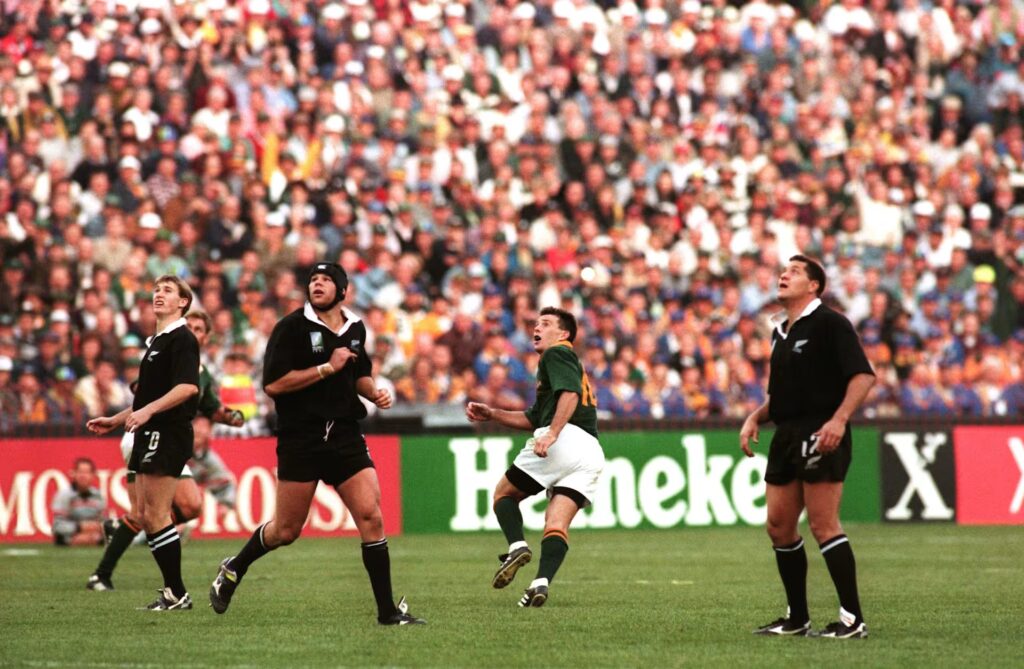
The match remained scoreless until Joel Stransky broke the deadlock with a drop goal. The All Blacks responded with equal intensity, and by the end of regular time, the scoreboard showed 9–9. The stadium held its breath as the game moved into extra time—the first Rugby World Cup final ever to do so.
Fatigue was setting in, but adrenaline kept the Springboks alive. They continued to defend with everything they had, absorbing pressure from a New Zealand side desperate to break through. When Stransky lined up for what would become one of the most famous drop goals in history, the moment seemed to pause. The ball sailed cleanly through the posts, and Ellis Park exploded in sound.
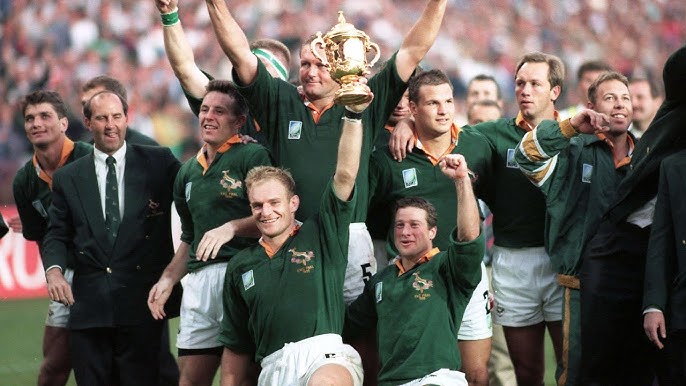
Fifteen years of struggle, transformation, and cautious optimism converged in that instant. The Springboks had won the World Cup, 15–12.
The Aftermath: More Than a Trophy
The celebrations that followed were unlike anything South Africa had witnessed. Streets across the country filled with people who, not long before, might never have stood side by side in public. Strangers embraced. Flags waved from township homes and suburban lawns alike. It was spontaneous, unscripted, and profoundly human—a moment where identity felt shared rather than segregated.
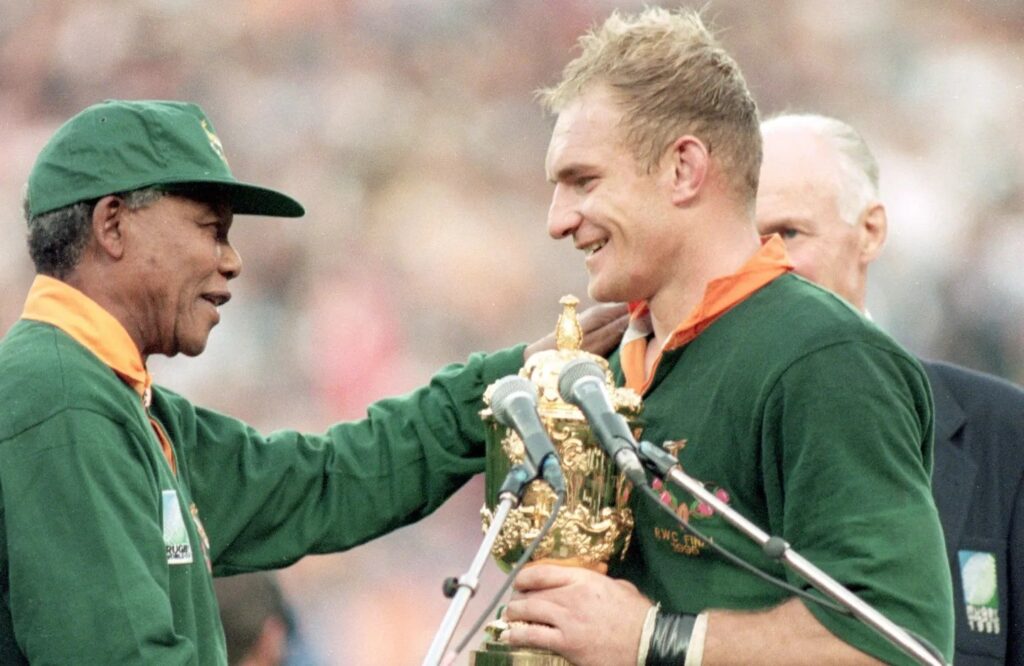
For many, the memory of Nelson Mandela presenting the Webb Ellis Cup to Francois Pienaar remains the most powerful symbol of reconciliation. Pienaar’s words echoed across the globe: “We didn’t have 60,000 South Africans supporting us today; we had 43 million South Africans.” It was more than a line in a victory speech—it was a truth that millions had felt in their bones.
The Legacy That Continues to Shape Today
Nearly three decades later, the 1995 Rugby World Cup continues to influence South Africa’s national consciousness. The event is taught in schools, referenced in political speeches, and revisited in documentaries and films. Yet its impact is not about nostalgia alone—it’s about what it represented and still represents.
The victory demonstrated the possibility of unity in a country where unity once seemed impossible. It gave South Africans a shared memory that transcended bitter histories and offered a sense of collective accomplishment. It reminded the world that sport can serve as a powerful cultural bridge, capable of dissolving barriers that politics and policy alone cannot break.
The 1995 triumph also sparked long-term transformation within rugby itself. The sport gradually evolved into something more inclusive, drawing talent from communities previously marginalized from the game. It helped create a pathway toward a more diverse Springbok team—one that would eventually produce champions again in 2007, 2019, and 2023, each victory building on the legacy of 1995.
Most importantly, the memory of that day remains a symbol of hope during difficult times. Whenever South Africa faces moments of tension or uncertainty, the story of 1995 resurfaces as a reminder of what is possible when unity triumphs over division.
Why the Moment Still Matters
The significance of the 1995 Rugby World Cup is not merely historical—it is emotional. It is about a nation experiencing itself differently, even if only for a moment, and discovering that unity was not a distant dream but a living experience. Such moments become anchors in a country’s identity. They shape how a nation sees itself and how it tells its own story to the world.
South Africa has faced many challenges since 1995, some of them steep and overwhelming. Yet the memory of that day retains its power because it embodies what the country aspires to be: resilient, diverse, united, and capable of finding strength in shared purpose.
In the end, the 1995 Rugby World Cup was more than a championship. It was a narrative pivot—a point at which the nation chose to believe in its own capacity for transformation. And though time has passed and new generations have emerged, the echoes of that historic victory still pulse through South Africa’s beating heart, reminding all who remember that unity, even in its most fragile form, can be profoundly transformative.
A victory written into history is never just about the past—it is about the story a nation continues to tell about itself. South Africa’s triumph in 1995 remains one of its most powerful chapters, and its influence continues to shape the country today in ways both visible and deeply felt.